Round Liner vs Magnum — What Professional Artists Actually Use
The round liner and the magnum are the two most used cartridge configurations in professional tattooing. Every working artist uses both — but knowing when to use each, and why, is what separates deliberate technique from guesswork.
This page covers the functional difference between round liners and magnums, how each performs across different applications, and how to build a cartridge setup that uses both configurations where they actually belong.
The Fundamental Difference
The difference between a round liner and a magnum is not just size — it's geometry, and geometry determines function.
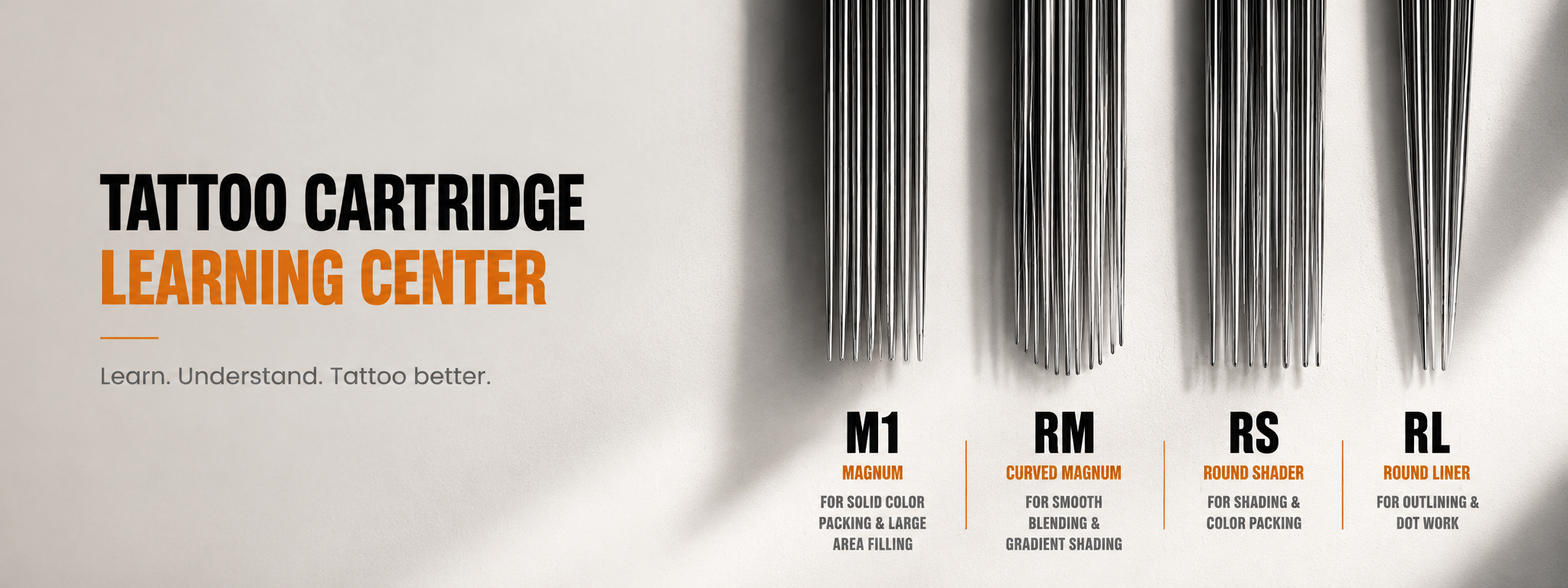
Round Liner (RL) — needles grouped in a tight circle. All needle tips converge toward a single central point. The result is a precise, defined point of ink deposit. Every stroke places ink in a controlled, consistent area.
Magnum (M) — needles arranged in two parallel rows across a flat plane. Multiple needle tips contact the skin simultaneously across a wider surface. The result is more ink per stroke, wider coverage, and faster saturation across larger areas.
These are fundamentally different tools designed for fundamentally different jobs. Trying to pack color with a round liner is inefficient. Trying to draw a clean outline with a magnum is imprecise. Both configurations have their domain — and professional tattooing uses both within the same session.
Round Liner — What It's Built For
The round liner is the precision instrument of the two. Its tight circular grouping is engineered for mark-making where accuracy and edge definition are the primary requirements.
How It Performs
On each stroke, the round liner deposits ink in a small, controlled circle. The needle tips converge toward the center, which means the ink deposit is concentrated and precise. Line edges are clean and defined. Dot placement is accurate.
The tighter the grouping — the fewer needles, or the more tightly they're packed — the more precise the mark. A 3RL (3-needle round liner) makes a very fine, precise line. A 14RL makes a bold, heavy outline with more ink per stroke but still with defined edges.
Applications
Outlines and structural linework — the primary application. Round liners lay down clean, consistent lines across all tattoo styles. From fine geometric linework to bold traditional outlines, the round liner is the outline tool.
Fine line tattooing — fine line work is almost exclusively done with small round liners. 1RL through 5RL covers the full range from single-needle micro detail to multi-needle fine line compositions.
Script and lettering — script requires precise, consistent line weight across complex curves and angles. The round liner's controlled deposit keeps letter edges clean and consistent through directional changes.
Dotwork — individual dot placement requires a precise, repeatable mark. The round liner in small sizes (3RL, 5RL) places dots consistently across thousands of repetitions in dotwork and geometric shading.
Detail work within compositions — skin texture details, hair strands, catchlights, fine interior lines within a larger piece. Any element requiring precision placement uses a round liner.
Size Selection for Round Liners
| Size | Needles | Application |
|---|---|---|
| 1RL | 1 | Single-needle, ultra-fine detail |
| 3RL | 3 | Fine line, precise script, dotwork |
| 5RL | 5 | Fine to medium linework, detail |
| 7RL | 7 | Medium outlines, standard fine line |
| 9RL | 9 | Standard to bold outlines |
| 11RL | 11 | Bold outlines, traditional styles |
| 14RL | 14 | Heavy outlines, bold traditional |
Most professional artists working in fine line use 3RL through 7RL as their primary sizes. Traditional and neo-traditional artists typically work in 7RL through 14RL for primary outlines, with smaller sizes for interior detail.
Magnum — What It's Built For
The magnum is the coverage and saturation tool. Its two-row flat arrangement puts more needle tips in contact with the skin per stroke, which means more ink deposited per pass across a wider area.
How It Performs
On each stroke, the magnum deposits ink across the full width of the needle arrangement. Where a round liner makes a single point, a magnum makes a band — wider coverage, more pigment, faster saturation.
The flat edge of a standard magnum produces a defined boundary on both sides of each pass. This makes it efficient for solid fill but requires technique to avoid hard edge lines within a color field — overlapping passes with a slight angle and consistent pressure management keeps the fill even.
Applications
Color packing — the primary application. The magnum's wide coverage and high ink capacity per pass makes it the most efficient tool for packing saturated, opaque color into large areas. Traditional color, neo-traditional fill, solid Japanese traditional color — all packed with a magnum.
Large area solid fill — black fill, background color, solid panels in large-scale pieces. The magnum covers ground quickly and evenly where a round shader would require significantly more passes.
Bold traditional work — heavy color saturation is a defining characteristic of traditional tattooing. The magnum is the tool that achieves that saturation efficiently — deep reds, dense blacks, bright yellows — without over-working the skin.
Background shading at scale — large background areas that need even tonal coverage rather than precise gradient work. The magnum covers background area faster than any round configuration.
Size Selection for Magnums
| Size | Needles | Application |
|---|---|---|
| 7M | 7 | Small area fill, tight spaces |
| 9M | 9 | Standard fill, medium areas |
| 11M | 11 | Large area coverage |
| 13M | 13 | Extensive fill, large traditional pieces |
| 15M | 15 | Maximum coverage, large scale work |
Most professional color artists use 9M through 13M as their primary fill sizes. The specific size depends on the scale of the color field — smaller sizes for tight areas with defined boundaries, larger sizes for open coverage.
Where They Overlap — and Where They Don't
There are applications where artists use both configurations in the same pass or the same area — and applications where one clearly wins.
Where Round Liner Wins
Any application requiring a defined edge. The round liner's concentrated deposit produces clean boundaries. Outlines, script edges, geometric borders, dotwork placement — precision requires a round liner.
Fine line work at any scale. No magnum configuration replicates the precision of a small round liner for fine line tattooing. The physics of the grouping geometry make this impossible.
Detail work within a larger composition. Interior details that require accurate placement always use a round liner regardless of the overall style.
Where Magnum Wins
Large area color saturation. Trying to pack solid color with a round shader or round liner is inefficient and traumatic to the skin — too many passes required to achieve the same saturation. The magnum achieves it in fewer passes with less skin stress.
Coverage speed. When you need to cover ground — large black fill, extensive color panels, background work across a large area — the magnum is the faster, more efficient tool.
Even fill across large areas. The magnum's consistent band deposit produces more uniform saturation across large areas than a round configuration, which requires more careful overlap management to achieve the same evenness.
Where Both Are Used in the Same Session
Most professional tattoo sessions use both configurations. A typical workflow:
- Round liner for all outline and structural linework
- Magnum (or curved magnum) for color packing and large fill areas
- Round shader for soft shading and tonal gradients
- Round liner (small) for detail work within the filled areas
The switch between configurations happens multiple times in a session. This is why cartridge compatibility and machine setup consistency matter — you want to switch configurations without significant machine adjustment.
Common Mistakes When Choosing Between Them
Using a round shader instead of a magnum for color packing. Round shaders deposit less ink per pass than magnums. For solid opaque color fill, a magnum is the correct tool. Round shaders are for soft, diffuse shading — not heavy saturation.
Using a magnum for linework. A magnum makes a band, not a line. It can be used for soft background gradients adjacent to linework, but it cannot replicate the precision of a round liner for actual lines.
Choosing too large a magnum for the area. A 15M in a small color field produces hard edges and uneven fill at the boundaries. Match magnum size to the scale of the area you're filling.
Using too small a round liner for bold outlines. A 3RL for bold traditional outlines requires excessive passes and produces inconsistent line weight at that scale. Match liner size to the line weight the style demands.
Building Your Round Liner and Magnum Setup
A practical professional setup covers the core sizes for both configurations without overstocking unnecessary sizes.
Round Liner essentials:
- 3RL or 5RL — fine line and detail
- 7RL or 9RL — standard outlines
- 11RL or 14RL — bold outlines (if your style requires it)
Magnum essentials:
- 9M or 11M — standard color packing
- 13M or 15M — large area coverage (if your work requires it)
Add curved magnum (CM) to the setup for blending and contoured surface work — it complements the flat magnum rather than replacing it.
The specific sizes depend on your style. A fine line specialist might never use anything larger than a 7RL and never touch a magnum. A traditional color artist might run 9RL through 14RL for outlines and 11M through 15M for fill. Know your style, stock accordingly.
Summary
Round liners and magnums are complementary tools, not competing ones. The round liner is the precision instrument — outlines, fine line, detail, dotwork. The magnum is the coverage tool — color packing, large fill, efficient saturation.
Professional tattooing uses both. The skill is knowing which application belongs to which configuration — and matching the size within each configuration to the scale of the work.
Continue Learning
Recommended for Artists