How Many Tattoo Cartridges Do You Need Per Session?
Knowing how many cartridges to prepare for a session is a practical studio skill that affects hygiene compliance, session flow, and supply economics. Running out of cartridges mid-session is a disruption that shouldn't happen. Overstocking every session is wasteful. The right number depends on session length, style, configuration switching, and the cartridge's own performance characteristics.
This guide breaks down cartridge consumption by session type, style, and duration — with practical stocking guidance for solo artists and multi-artist studios.
Why Cartridge Changes Happen
Before calculating how many cartridges you need, it's worth understanding why cartridges get changed during a session. There are four distinct reasons, and each contributes differently to total consumption:
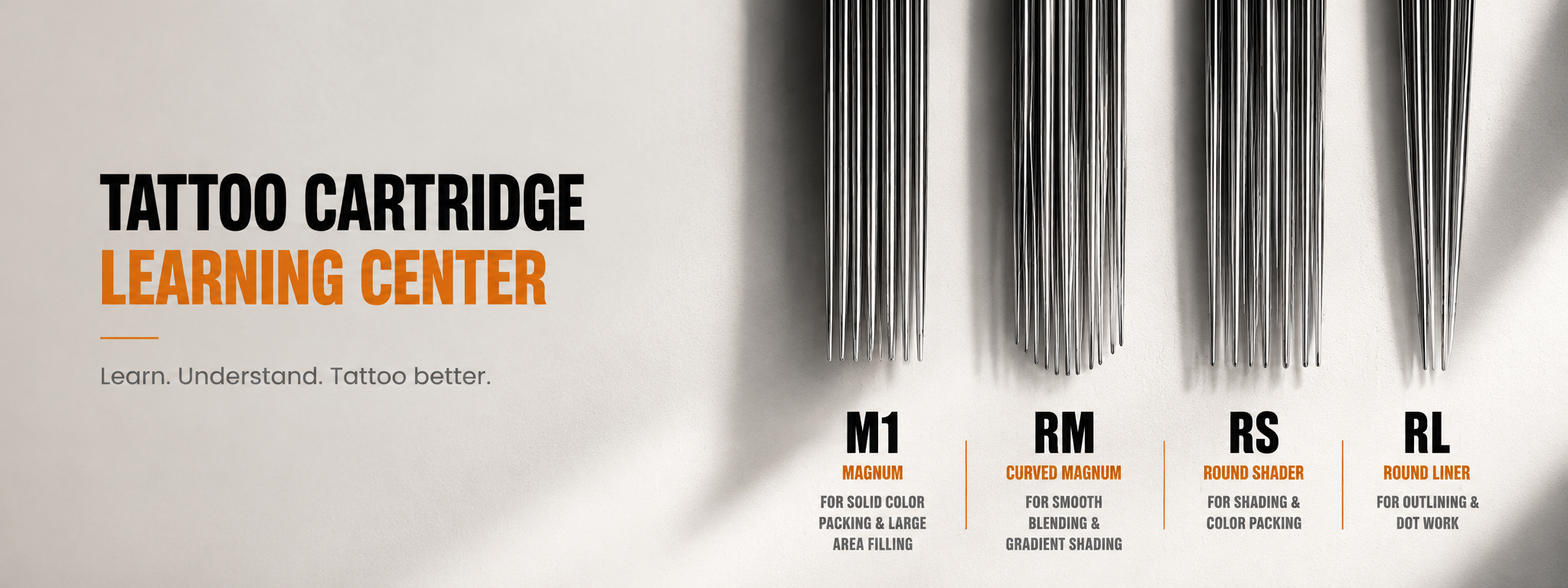
Configuration changes — switching from round liner to magnum to curved magnum as the session moves through different phases. Each configuration requires its own cartridge. A session that moves through three configurations uses at least three cartridges for that reason alone.
Hygiene compliance — cartridges are single-use per client. When a client leaves, all used cartridges are disposed of. Between clients, fresh cartridges start the new session.
Performance maintenance — membranes fatigue over extended sessions. Changing cartridges every 1–2 hours in a long booking maintains consistent membrane performance, even if the needle isn't worn out. This is professional practice, not wastage.
Needle wear — needles dull slightly over extended use, particularly through resistant skin. A dull needle requires more pressure for the same penetration depth, which affects results and skin health. Changing when needle feel changes maintains consistent quality.
Cartridge Consumption by Session Length
Short Session (1–2 Hours)
Typical consumption: 2–5 cartridges
A short session usually involves one or two configuration types — outline and shading, or shading only, or detail work only. Membrane fatigue is minimal over two hours. Configuration switching is the primary driver of cartridge use.
Examples:
- Touch-up session: 1–2 cartridges
- Small fine line piece: 2–3 cartridges (one liner size through the session)
- Small color piece: 3–5 cartridges (liner + shader + magnum)
Stocking recommendation: 5–8 cartridges per configuration in the session. Enough to cover the session with backup for unexpected needle changes.
Standard Session (3–4 Hours)
Typical consumption: 5–10 cartridges
A standard professional booking covers significant ground — enough for a medium piece or a substantial portion of a larger one. Configuration switching increases, and one performance-maintenance change per configuration is standard practice.
Examples:
- Medium fine line piece: 3–5 cartridges
- Medium black and grey realism: 5–8 cartridges (shader + liner, multiple changes)
- Medium color piece: 6–10 cartridges (liner + multiple magnums + curved magnum)
Stocking recommendation: 10–15 cartridges across configurations. Enough for the session with margin for performance changes and any unexpected issues.
Full Day Session (6–8 Hours)
Typical consumption: 10–20 cartridges
Full-day bookings are where cartridge consumption adds up significantly. Multiple configuration switches, regular performance-maintenance changes, and the higher total needle use across 6–8 hours of tattooing. This is the session type where cartridge economics matter most — and where bundle pricing has the biggest impact on studio supply costs.
Examples:
- Large scale fine line (sleeve session): 8–12 cartridges
- Full-day black and grey realism: 10–15 cartridges
- Full-day Japanese traditional (outline + color): 12–20 cartridges
- Full-day color work (multiple configurations): 15–20 cartridges
Stocking recommendation: 20–25 cartridges across configurations. A full 20PCS box per primary configuration plus backup in secondary configurations.
Cartridge Consumption by Style
Style affects consumption significantly — different styles use different numbers of configurations and change frequency.
Fine Line
Fine line is relatively cartridge-efficient — typically one or two round liner sizes throughout a session with minimal configuration switching.
| Session Length | Estimated Cartridges |
|---|---|
| 1–2 hours | 2–3 |
| 3–4 hours | 3–6 |
| 6–8 hours | 6–10 |
Fine line sessions use fewer cartridges than color or realism because configuration switching is minimal. The primary change driver is performance maintenance — changing liners every 2 hours in a long session.
Black and Grey Realism
Realism sessions use more cartridges than fine line because they switch between shader and liner configurations regularly, and because the detailed nature of the work benefits from frequent performance-maintenance changes.
| Session Length | Estimated Cartridges |
|---|---|
| 1–2 hours | 3–5 |
| 3–4 hours | 6–10 |
| 6–8 hours | 10–16 |
Japanese Traditional
Japanese traditional has among the highest cartridge consumption per session — heavy outline work with large round liners, followed by dense color packing with large magnums. Both configurations consume cartridges at higher rates than fine line or shading work.
| Session Length | Estimated Cartridges |
|---|---|
| 1–2 hours | 3–6 |
| 3–4 hours | 7–12 |
| 6–8 hours | 12–20 |
Color Work (Neo-Traditional, Illustrative)
Color sessions involve frequent configuration switching — liner, magnum, curved magnum — and color changes between the same configuration type. A session moving through multiple colors with multiple configurations lands at the higher end of consumption estimates.
| Session Length | Estimated Cartridges |
|---|---|
| 1–2 hours | 4–7 |
| 3–4 hours | 8–13 |
| 6–8 hours | 13–20 |
Dotwork and Geometric
Dotwork is cartridge-efficient from a configuration standpoint — typically one round liner size for the full session. Consumption is driven primarily by performance maintenance over long, repetitive sessions.
| Session Length | Estimated Cartridges |
|---|---|
| 1–2 hours | 2–3 |
| 3–4 hours | 3–5 |
| 6–8 hours | 5–8 |
When to Change Cartridges — Professional Guidelines
Change by Time
Every 1–2 hours in a standard professional session. This is the performance-maintenance change — not because the needle is visibly worn but because membrane fatigue accumulates over time and affects consistency. A fresh cartridge every 1–2 hours keeps the membrane performing at its calibrated level throughout the session.
For short sessions under 2 hours, a single-time change is often not necessary unless the needle feel changes or configuration requires it.
Change by Configuration
Every time you switch from one configuration to another — liner to shader, shader to magnum, magnum to curved magnum — a new cartridge. Never try to use a liner for shading or a magnum for linework to avoid a cartridge change. Configuration matching is non-negotiable for professional output.
Change by Feel
When the needle feels different — stiffer return, inconsistent flow, dry strokes that weren't there before — change the cartridge regardless of elapsed time. These are signals that the membrane has fatigued, the needle has dulled, or a manufacturing variance in that specific cartridge is affecting performance.
Don't compensate for a fatiguing cartridge by adjusting voltage or technique. Change it and start fresh.
Change Between Clients
Every client gets a fresh cartridge — no exceptions. This is hygiene compliance, not a performance consideration. All cartridges from a completed session are disposed of before the next client sits down.
Stocking Strategy for Solo Artists
Weekly Supply Estimate
A solo artist running 3–4 sessions per week across standard booking lengths (3–5 hours) typically consumes:
- 6–10 cartridges per session
- 20–40 cartridges per week
- 80–160 cartridges per month
One 20PCS box per primary configuration per week covers most solo artist working volumes. For a round liner + round shader + magnum setup, that's 3 boxes per week — 12 boxes per month.
Bundle Buying for Solo Artists
The BigWasp 10 Box Bundle (18% savings) covers approximately 1 month of supply for a solo artist running standard volume. At 18% off, you're stocking a full month's professional supply at a per-cartridge cost that makes the bundle the obvious economic choice over single-box ordering.
Order by primary configuration — 10 boxes of round liner if that's your primary, and single boxes of secondary configurations until you've confirmed your consumption rate.
Stocking Strategy for Multi-Artist Studios
Weekly Supply Estimate (3 Artists)
A studio running 3 artists across varied styles and session lengths typically consumes:
- 15–30 cartridges per artist per week
- 45–90 cartridges per week total
- 180–360 cartridges per month
Bundle Buying for Studios
The BigWasp 20 Box Bundle (25% savings) is designed for studio volume. At 400 cartridges per bundle order, it covers 1–2 months of supply for a 2–3 artist studio depending on session volume.
Studio stocking strategy:
- Identify the top 2–3 configurations used across all artists
- Order 20-box bundles in those configurations monthly
- Keep secondary configuration stock at single-box level until consumption patterns are established
- Review and adjust monthly based on actual consumption
Cartridge Consumption and Session Planning
Building cartridge consumption into session planning prevents mid-session supply gaps.
Pre-session checklist:
- Confirm session length and style
- Identify all configurations needed for the session
- Count cartridges available per configuration
- Ensure minimum 5 cartridges per configuration for sessions under 4 hours
- Ensure minimum 10 cartridges per primary configuration for full-day sessions
Mid-session signals to change:
- 2 hours elapsed on the same cartridge
- Needle feel has changed
- Ink flow has become inconsistent
- Any configuration switch
Post-session:
- Dispose of all used cartridges from the session
- Note actual consumption for supply planning
- Restock before the next session rather than during it
The Economics of Getting This Right
Cartridge overconsumption — changing too frequently from excessive caution — adds unnecessary cost. Underconsumption — running cartridges longer than their optimal performance window — compromises results and hygiene standards. The right consumption rate sits between them.
At BigWasp Energy bundle pricing:
- 10 Box Bundle (18% off): ~200 cartridges at reduced per-cartridge cost
- 20 Box Bundle (25% off): ~400 cartridges at the lowest per-cartridge cost
For a solo artist consuming 120 cartridges per month, the 10 Box Bundle ordered monthly covers supply with margin. The 18% saving on a monthly basis adds up to meaningful annual savings compared to single-box purchasing — without any compromise in cartridge quality or availability.
For a studio consuming 300+ cartridges per month, the 20 Box Bundle ordered monthly or bi-monthly is the most economical professional supply structure available at this performance level.
Summary
Cartridge consumption per session depends on session length, style, configuration switching frequency, and performance maintenance practice. Short sessions use 2–5 cartridges. Standard sessions use 5–10. Full-day bookings use 10–20.
Change cartridges by time (every 1–2 hours), by configuration switch, by feel (when performance changes), and always between clients. Never compensate for a fatiguing cartridge by adjusting technique — change it.
Stock based on actual consumption patterns. Solo artists typically need one 20PCS box per primary configuration per week. Studios need significantly more, with 20-box bundle ordering the most economical structure for consistent professional volume.
Continue Learning
Recommended for Artists