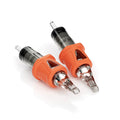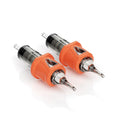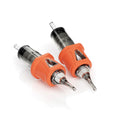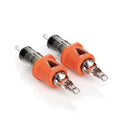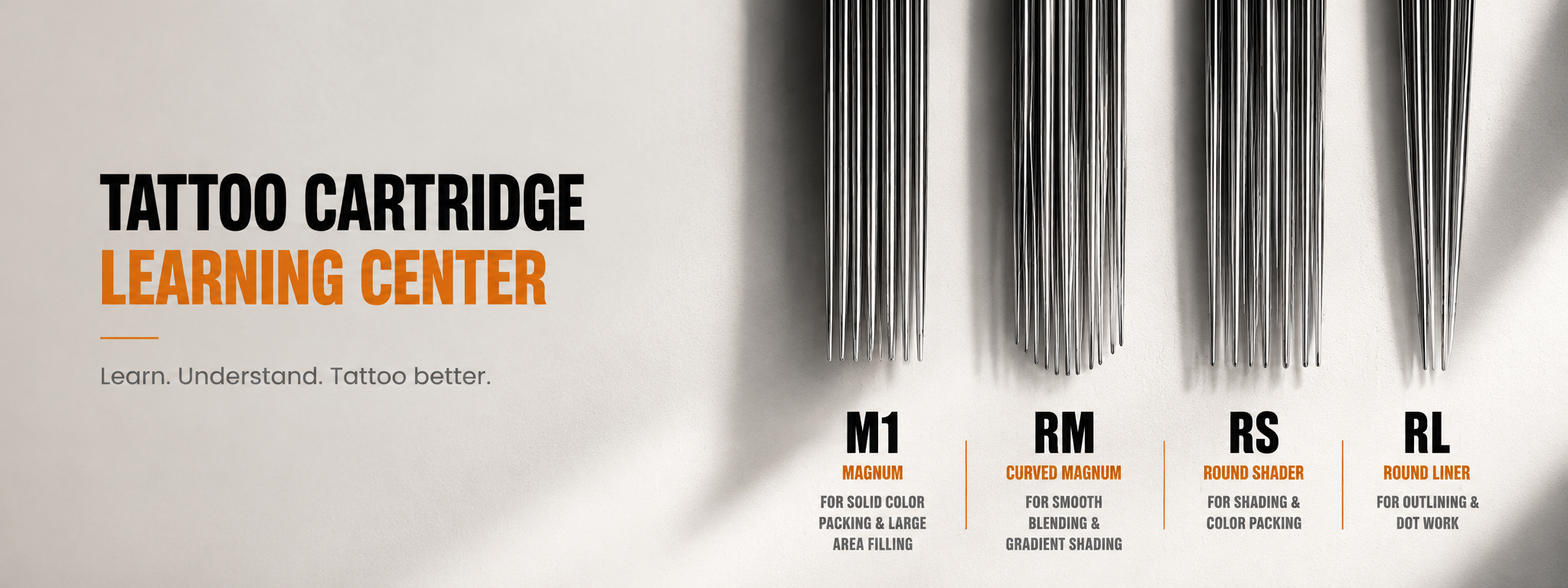
How Tattoo Cartridges Work
Understanding how a tattoo cartridge actually functions — mechanically, during a session — changes how you troubleshoot problems, choose equipment, and evaluate cartridge quality. Most artists know what cartridges do. Fewer understand the mechanics well enough to know why one performs differently from another.
This page covers the full mechanical picture: how the needle moves, how ink flows, what the membrane does on each stroke, and what happens inside the cartridge during extended use.
The Basic Mechanism
A tattoo cartridge works by converting the rotary motion of the tattoo machine motor into a linear up-and-down needle movement. Here's the sequence on every stroke:
- The machine drive mechanism pushes the cartridge needle bar downward
- The needle extends through the tip and penetrates the skin
- Ink is deposited at the needle depth
- The drive mechanism retracts — the needle pulls back up into the cartridge body
- The membrane returns to its resting position
- The cycle repeats — typically 80 to 150 times per second depending on machine speed
Each complete cycle is one stroke. At standard working speeds, this happens so fast it's imperceptible as individual movements — what you feel is the machine's vibration and what you see is continuous ink deposit.
How Ink Gets to the Needle
Ink doesn't flow through the cartridge under pressure the way it would through a syringe. It moves through a combination of surface tension, capillary action, and the needle's movement through the ink reservoir at the tip.
Here's what actually happens:
Loading the cartridge: When you dip the needle into ink, capillary action draws ink up between the needle tips and holds it there through surface tension. The ink sits in the needle grouping at the tip of the cartridge — not stored inside the body.
During the stroke: As the needle drives into the skin, the surface tension breaks at the point of skin contact and ink is deposited. The needle carries a small amount of ink on each downstroke and deposits it at the depth of penetration.
Between strokes: The needle retracts back into the tip, drawing slightly more ink from the reservoir through capillary action. This keeps the needle tips loaded for the next stroke.
Re-dipping: When the ink on the needle tips depletes, you re-dip. The frequency depends on ink viscosity, needle grouping size, working speed, and cartridge ink retention — all of which vary between cartridge designs.
What the Membrane Does on Every Stroke
The safety membrane is the most mechanically active component in the cartridge, and understanding its role explains why membrane quality affects performance so directly.
On every downstroke:
- The needle bar pushes downward through the cartridge
- Air pressure inside the cartridge body increases as the needle displaces volume
- The membrane flexes outward slightly to equalise that pressure
- This controlled flex maintains consistent ink delivery to the needle tips
On every upstroke:
- The needle retracts
- Pressure inside the cartridge decreases
- The membrane returns to its resting position
- This return movement creates a slight vacuum that pulls ink back toward the needle tips — maintaining capillary loading for the next stroke
The membrane also acts as a physical barrier. As the needle retracts, any ink or blood that has entered the tip area is prevented from travelling further back into the cartridge body and grip by the membrane. This is the backflow prevention function — and it's what makes cartridges safe for professional use.
A membrane that loses tension degrades both functions. The pressure equalisation becomes inconsistent, which affects ink flow. The backflow barrier weakens, which creates hygiene risk. Both problems compound over time in a session — which is why membrane durability under extended use is a critical spec, not just an initial quality marker.
Ink Flow — Consistent vs Inconsistent
Consistent ink flow means every stroke deposits approximately the same amount of ink at approximately the same depth. Inconsistent ink flow means variable deposit — too much on some strokes, too little on others — which produces uneven saturation, patchy fill, and lines that vary in weight.
Several factors affect ink flow consistency:
Membrane tension. A membrane with consistent, calibrated tension produces predictable pressure equalisation on every stroke. Variable tension produces variable flow.
Needle grouping tightness. A tight, stable grouping maintains consistent contact between needle tips, which keeps capillary loading even. A loose grouping that shifts under pressure changes how ink sits on the tips between strokes.
Tip geometry. The shape and diameter of the tip opening affects how smoothly the needle moves through ink during the stroke cycle. A well-engineered tip maintains consistent resistance — enough to hold ink by surface tension, not so much that it disrupts flow.
Ink viscosity. Thicker inks (dense black, opaque traditional colors) behave differently from thinner inks (diluted grey wash, watercolor-style pigments). A cartridge engineered for consistent flow handles variable viscosity better than one built to a lower tolerance spec.
Working speed. Higher machine speeds cycle the needle faster, which changes how much time the capillary loading has between strokes. Most professional cartridges are engineered for the standard working speed range — very high or very low speeds can affect flow behaviour.
What Changes During an Extended Session
A cartridge that performs well for the first hour of a session needs to perform the same in hour three. Here's what degrades over time and why it matters:
Membrane fatigue. The membrane flexes on every stroke — at 100 strokes per second, that's 360,000 flexes per hour. A membrane compound that loses elasticity under sustained cycling produces less consistent pressure equalisation as the session progresses. You feel this as a change in the needle's return behaviour — slightly different resistance, slightly different flow.
Needle tip wear. Needle tips dull slightly over extended use, particularly through skin with significant resistance. A duller needle requires slightly more pressure for the same penetration depth, which changes how ink deposits and how the skin responds. This is why changing cartridges during a long session is standard professional practice — not just hygiene, but performance maintenance.
Ink residue buildup. Ink dries on the needle tips and tip geometry during the session, which can affect how cleanly ink flows. Wiping the tip regularly during the session — standard practice — manages this. A cartridge with a transparent body lets you see when buildup is affecting flow before it affects the skin.
Temperature. Extended machine use generates heat. Heat affects ink viscosity and, to a lesser degree, the silicone membrane compound. Professional-grade silicone membranes are engineered to maintain performance across normal session temperature ranges.
How Cartridges Differ from Traditional Needle Bars
Before cartridges, professional tattooing used separate needle bars — needles soldered to a bar, loaded into a tip, secured to a grip, and used with coil or rotary machines. Understanding the difference explains why cartridges have become the professional standard.
Setup time: A needle bar setup requires assembling multiple components, securing the needle depth, and ensuring the tip is sealed. A cartridge drops into a compatible grip and is ready in seconds.
Hygiene: Traditional needle bars require thorough cleaning and sterilization between uses — or single use with full disposal of tip and bar. Cartridges are inherently single-use by design, with the safety membrane providing an additional layer of contamination protection.
Consistency: Traditional setups vary based on how precisely the needle is assembled and secured. Cartridges are factory-assembled to consistent tolerances — the needle grouping, tip geometry, and membrane are calibrated in production rather than at the artist's bench.
Versatility: Switching configurations mid-session with traditional needle bars means breaking down and rebuilding the setup. Cartridges switch in seconds — drop out one, drop in another, continue working.
The tradeoff is that cartridge performance depends entirely on manufacturing quality. With traditional needle bars, an experienced artist could correct grouping issues manually. With cartridges, you're dependent on the brand's manufacturing tolerances — which is why choosing a cartridge with documented specs and consistent batch quality matters.
Common Cartridge Problems and Their Causes
Ink flow stops mid-stroke: Usually a dry needle — the ink on the tips has depleted. Re-dip and continue. If it recurs frequently, the cartridge may have lower ink retention than expected or the ink viscosity is affecting capillary loading.
Ink leaking into the grip: Membrane failure — the backflow barrier has been compromised. This can happen with very low-quality membranes under sustained use, or if the cartridge is damaged. Replace the cartridge immediately.
Inconsistent line weight: Can be membrane tension variation (uneven pressure equalisation), a loose needle grouping (inconsistent tip loading), or voltage settings that don't match the cartridge's membrane resistance. Check cartridge first, then machine settings.
Cartridge doesn't seat properly: Grip compatibility issue. Most cartridges fit standard grips, but some grip designs have tighter tolerances. Confirm your grip is compatible with the cartridge brand.
Needle feels different between cartridges in the same box: Batch consistency issue. Professional-grade cartridges maintain tight manufacturing tolerances across the full box. Variable feel between cartridges from the same box suggests inconsistent production — a brand quality indicator worth paying attention to.
Summary
A tattoo cartridge is a precision-engineered single-use system that converts machine motion into controlled ink deposit. Every component — needle grouping, tip geometry, membrane compound, housing material — affects performance in ways that compound across a session.
The membrane is the most critical variable. The needle grouping determines what kind of mark is made. The tip affects visibility and flow. The housing material affects durability and how much you can see during work.
Understanding these mechanics is what allows you to evaluate cartridge specs intelligently rather than relying on brand reputation alone.
Continue Learning
- Cartridge Anatomy — Every Component Explained
- Round Liner vs Magnum — What Professional Artists Actually Use
Recommended for Artists