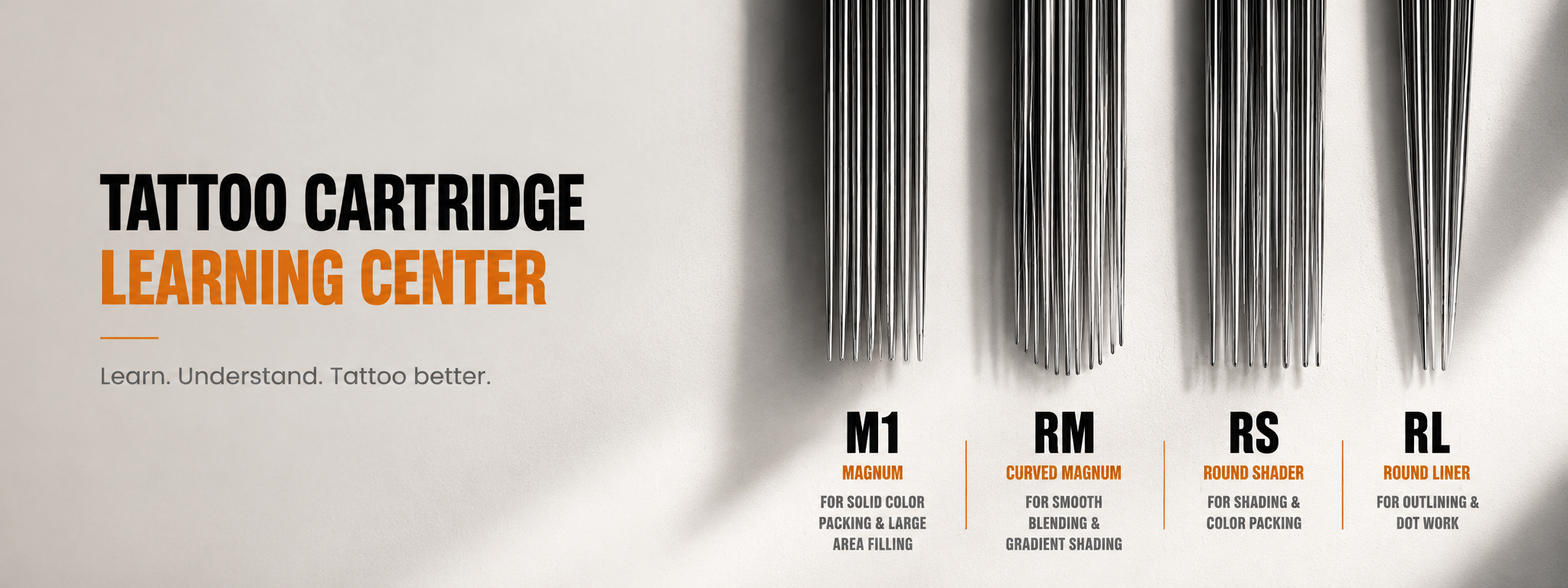
Choosing Cartridges by Tattoo Style — The Complete Guide
Cartridge selection by tattoo style is where technical knowledge meets practical application. Every style has specific demands — line weight requirements, shading technique, color saturation needs, and the precision level required for the defining characteristics of the work. Matching cartridge configuration, gauge, and membrane to those demands produces better results with less compensatory technique.
This guide covers the primary professional tattoo styles and the cartridge setup that serves each one best — configuration, gauge, taper, and membrane considerations for each.
Fine Line and Single Needle
Fine line tattooing is the most demanding style for cartridge precision. Lines are the primary design element, and their quality — consistency, edge definition, and weight accuracy — is immediately visible in the finished work.
Primary Configuration
Round Liner (RL) — the only configuration for fine line work. Sizes 1RL through 7RL cover the full fine line range from single-needle micro detail to multi-needle fine line compositions.
Gauge
#10 (0.30mm) — the standard for fine line. Finer wire diameter produces finer marks with cleaner edges and less lateral ink spread in the skin. #08 (0.25mm) or smaller for single-needle specialists working at the finest scale.
Taper
Long taper — gradual skin entry, minimal tissue displacement, crisper line edges. Standard for fine line across all sizes. Super long taper for single-needle specialists.
Membrane
High-elastic or high-quality silicone — low voltage fine line work requires membrane sensitivity at the lower end of the voltage range. High-elastic membranes track subtle pressure changes more accurately, giving more control over ink deposit per stroke.
Recommended Setup
- Primary: 3RL or 5RL, #10, long taper
- Detail: 1RL, #08, long taper
- Extended sessions: high ink retention cartridge for consistency across long detail passes
Black and Grey Realism
Black and grey realism requires both precise detail and smooth tonal transitions in the same piece — the cartridge setup needs to handle both applications without significant machine adjustment between them.
Primary Configurations
Round Shader (RS) for tonal passages — soft shading, gradient building, skin tone foundation. Round Liner (RL) in small sizes for detail work — skin texture, hair definition, structural lines, catchlights.
Gauge
#10 (0.30mm) — finer gauge gives more control over tonal building at low voltage. Less ink per stroke means more gradual tonal build, which is the foundation of smooth gradient realism.
Taper
Long taper — across both round shader and round liner for realism. Precise skin entry and controlled ink deposit at the subtle pressure ranges realism requires.
Membrane
High-elastic silicone — realism shading operates across a wide voltage range within a single session. A membrane that responds accurately to subtle voltage reductions gives tighter tonal control at the lighter end of the gradient.
Recommended Setup
- Shading: 7RS or 9RS, #10, long taper
- Detail: 3RL or 5RL, #10, long taper
- Extended portrait sessions: high ink retention cartridge for detail passes
Portrait Tattooing
Portrait work adds hyper-detail requirements to the realism skill set. The ability to render recognisable facial features at skin scale requires the finest marks and the most precise ink deposit available in professional cartridge tattooing.
Primary Configurations
Round Liner (RL) in small sizes for all fine detail — facial structure lines, hair, eyelashes, skin pore texture. Round Shader (RS) for tonal foundation and skin tone passages.
Gauge
#10 (0.30mm) standard. #08 (0.25mm) for the finest detail work — skin texture, individual hair strands, micro detail that defines portrait precision.
Taper
Long to super long taper — the finest marks at the finest gauge require the most gradual skin entry available.
Membrane
High-elastic, high ink retention — extended portrait sessions involve thousands of repeated light detail passes. A membrane with both high elasticity (for tonal control) and excellent ink retention (for consistent deposit across long detail passes without frequent re-dipping) is the combination portrait work demands.
Recommended Setup
- Primary detail: 3RL, #10, long taper
- Fine texture: 3RL or 5RL, #08, long taper
- Tonal shading: 7RS or 9RS, #10, long taper
Japanese Traditional
Japanese traditional has two distinct cartridge requirements — heavy bold outlines and dense flat color fill — that need different configurations and often different gauge choices.
Primary Configurations
Round Liner (RL) in large sizes for primary outlines — 9RL through 14RL for the bold, weighted outlines that define Japanese traditional composition. Magnum (M) for color fill — dense, opaque color packing across large flat areas. Curved Magnum (CM) for color on contoured anatomy and color transitions.
Gauge
#12 (0.35mm) — standard gauge for both outline and fill. The larger wire carries more ink per stroke, which is efficient for the heavy outlines and dense color saturation Japanese traditional requires.
Taper
Medium taper — for both outline and fill. Efficient ink deposit is the priority over precision entry. Long taper is used by some artists for cleaner outline edges on finer structural lines within the composition.
Membrane
High-quality silicone, enhanced ink flow — Japanese traditional sessions run long and involve heavy color packing with high-viscosity opaque pigments. A membrane that handles thick pigment flow consistently and maintains performance across extended sessions is critical.
Recommended Setup
- Primary outlines: 9RL–14RL, #12, medium taper
- Color fill: 11M or 13M, #12, medium taper
- Contoured fill and transitions: 11CM or 13CM, #12, medium taper
Neo-Traditional
Neo-traditional combines bold linework with illustrative color — heavier line weights than fine line, more refined than bold traditional. The color work is often semi-saturated rather than fully opaque, requiring more blending capability than standard traditional.
Primary Configurations
Round Liner (RL) for structured outlines — 7RL through 11RL for neo-traditional line weights. Curved Magnum (CM) for color blending and gradient transitions — the curved arc suits the smooth color work that distinguishes neo-traditional from bold traditional. Magnum (M) for solid fill areas where needed.
Gauge
#12 (0.35mm) — versatile across both line and color work at neo-traditional scale.
Taper
Medium to long taper — medium for outline work where ink deposit speed matters, long for blending passes where precision and soft edges are the priority.
Membrane
High-quality silicone — covers both the outline and color blending demands of neo-traditional without requiring specialist membrane characteristics.
Recommended Setup
- Outlines: 7RL–11RL, #12, medium taper
- Color blending: 9CM–13CM, #12, medium to long taper
- Solid fill: 9M–11M, #12, medium taper
Traditional (American and European)
Bold traditional tattooing prioritises heavy outlines, flat saturated color, and designs that read clearly at distance and hold over decades. The cartridge requirements are among the most straightforward in professional tattooing — maximum ink deposit efficiency is the primary variable.
Primary Configurations
Round Liner (RL) in large sizes — 9RL through 14RL for primary outlines. The heaviest line weights in professional tattooing. Magnum (M) for color fill — solid, opaque color in large flat panels.
Gauge
#12 (0.35mm) standard. #14 (0.40mm) for the heaviest outlines where maximum line weight is a style requirement.
Taper
Medium taper — efficient ink deposit is the priority. Long taper is unnecessarily precise for bold traditional applications.
Membrane
Standard to high-quality silicone — bold traditional doesn't require membrane sensitivity. Consistency and durability across a long color session are the relevant membrane characteristics.
Recommended Setup
- Primary outlines: 11RL–14RL, #12–#14, medium taper
- Color fill: 11M–15M, #12, medium taper
Geometric and Dotwork
Geometric and dotwork tattooing is built on precision and repetition. Every mark needs to be the same size and density — consistency across thousands of individual marks is the defining technical requirement.
Primary Configuration
Round Liner (RL) — dotwork and geometric linework both use round liners. The tight grouping produces the precise, repeatable mark that geometric work demands. Sizes 3RL through 9RL cover the full range from fine geometric lines to bolder structural outlines.
Gauge
#10 (0.30mm) — precise mark-making at the smaller end of standard professional gauge. #12 for bolder geometric outlines.
Taper
Long taper — precise skin entry, clean dot edges, consistent mark size across thousands of repetitions.
Membrane
High ink retention — dotwork involves placing marks in deliberate succession with pauses between them. A cartridge with excellent ink retention keeps the needle tips loaded consistently between marks, producing more uniform dot density across a long dotwork shading field.
Recommended Setup
- Fine geometric and dotwork: 3RL–5RL, #10, long taper
- Standard geometric lines: 7RL–9RL, #10–#12, long taper
- Bold geometric outlines: 9RL–11RL, #12, medium to long taper
Watercolour and Illustrative
Watercolour and illustrative styles require soft, diffuse ink application — the opposite of the defined, saturated marks of traditional tattooing. Light, buildable ink deposit and soft edge control are the primary cartridge requirements.
Primary Configurations
Round Shader (RS) — soft, diffuse deposit for watercolour washes and illustrative shading. Curved Magnum (CM) — for larger soft color passages and smooth color transitions. Round Liner (RL) in small sizes for any structural line elements within the composition.
Gauge
#10 (0.30mm) — finer gauge, less ink per stroke, more control over the light, buildable deposit that watercolour technique requires.
Taper
Long taper — gradual entry, soft deposit, less skin disruption per stroke for the light, repeated passes of watercolour technique.
Membrane
High-elastic silicone — watercolour work operates at the low end of the voltage range for maximum control over ink deposit per stroke. High-elastic membranes respond more sensitively at low voltage.
Recommended Setup
- Colour washes: 7RS–9RS, #10, long taper
- Large soft passages: 9CM–11CM, #10, long taper
- Structural lines: 3RL–5RL, #10, long taper
Cover-Up Work
Cover-up tattooing presents specific cartridge demands — you're depositing ink over existing tattoos, which means working through scar tissue and existing pigment. The skin is typically more resistant, and ink saturation requirements are higher than on virgin skin.
Primary Configurations
Magnum (M) for color packing over existing work — maximum ink deposit per pass for efficient saturation through resistant skin. Round Liner (RL) for outline work — heavier sizes than you might use on clean skin to achieve sufficient line weight over existing pigment.
Gauge
#12 (0.35mm) — standard gauge handles the demands of cover-up work. Some artists move to #14 for particularly resistant skin or dense existing pigment.
Taper
Medium taper — assertive entry is an advantage for cover-up work. The more aggressive tissue displacement of medium taper (compared to long taper) suits the denser skin conditions of cover-up tattooing.
Membrane
High-quality silicone, enhanced ink flow — cover-up sessions often run long and require consistent heavy ink deposit. A membrane that handles sustained color packing without fatiguing is the relevant spec.
Recommended Setup
- Color packing: 11M–15M, #12, medium taper
- Outlines: 9RL–14RL, #12, medium taper
Style-to-Cartridge Quick Reference
| Style | Primary Config | Gauge | Taper | Membrane |
|---|---|---|---|---|
| Fine line | RL (small) | #10 | Long | High-elastic |
| Single needle | RL (1RL–3RL) | #08–#10 | Long–Super long | High-elastic |
| Black and grey realism | RS + RL | #10 | Long | High-elastic |
| Portrait | RL (small) + RS | #08–#10 | Long | High-elastic, high retention |
| Japanese traditional | RL (large) + M | #12 | Medium | High-quality |
| Neo-traditional | RL + CM | #12 | Medium–Long | High-quality |
| Bold traditional | RL (large) + M | #12–#14 | Medium | Standard–High-quality |
| Geometric / dotwork | RL | #10–#12 | Long | High retention |
| Watercolour | RS + CM | #10 | Long | High-elastic |
| Cover-up | M + RL (large) | #12 | Medium | High-quality |
Summary
Every tattoo style has a cartridge setup that serves it best — not by accident, but because the configuration, gauge, taper, and membrane characteristics align with what the technique demands. Fine line precision requires small round liners in fine gauge with long taper and elastic membranes. Bold traditional efficiency requires large round liners and magnums in standard gauge with medium taper. Realism tonal control requires elastic membranes and fine gauge across both shader and liner configurations.
Match your cartridge to your style and technique. The right setup makes the technical demands of your work easier to meet — not harder. And when a new style requires a different setup, the decision framework is the same: identify what the technique demands, then match configuration, gauge, taper, and membrane to those demands.
Continue Learning
Recommended for Artists