
What you'll learn
◎
Cartridge Basics
Learn how tattoo cartridges work, their anatomy, and why different needle configurations exist.
◎
Choosing the Right Cartridge
Understand which cartridges work best for lining, shading, blending, and color packing.
◎
Technical Knowledge
Explore needle gauges, taper lengths, membranes, ink flow, and cartridge compatibility.
◎
Professional Tips
Improve your workflow with practical advice on storage, hygiene, and session planning.
Learning Paths
Cartridge Basics
Technical Guides
Choosing Cartridges
Maintenance & Best Practices
Featured Guides
Start Here
Ultimate Tattoo Cartridge Guide
Everything from cartridge anatomy to professional
techniques. The complete reference for any tattoo artist.
Read →
Needle Gauge Guide
0.30mm vs 0.35mm — what the numbers mean
and how gauge affects your work.
Read →
Round Liner vs Magnum
The two most used configurations explained - when to use each and why it matters.
Read →
Recommended for Artists
The cartridges behind the knowledge.
Frequently Asked Questions
-
Tattoo cartridges are single-use needle systems that attach to compatible rotary machines. They combine the needle, tip, and a safety membrane into one disposable unit — making setup faster, cleaner, and safer than traditional needle bars.
-
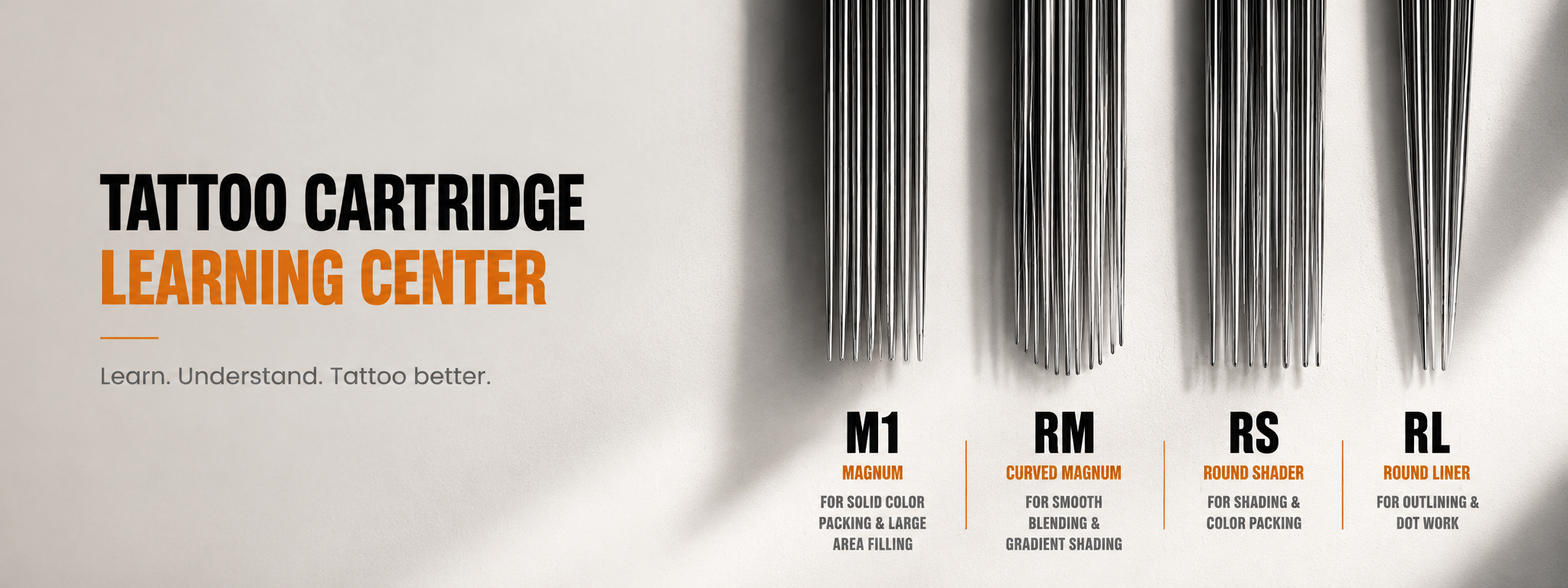
RL (Round Liner) is used for outlines, fine line work, and detail. RS (Round Shader) is used for soft shading and gradients. The difference is in the needle grouping geometry — round liners are tightly grouped for precision, round shaders are spaced slightly wider for softer ink deposit.
-
0.30mm (#10) gives more precision and is better for fine detail, single-needle work, and delicate techniques. 0.35mm (#12) is the standard for most professional applications — lining, shading, and color packing. When in doubt, start with #12.
-
Most professional artists change cartridges every 1–2 hours or between major configuration changes. Never reuse a cartridge across multiple clients. If ink flow becomes inconsistent or the needle feels dull, change it immediately regardless of time elapsed.
-
Most cartridges fit standard rotary machines and grips using the industry-standard connection system. Some machines use proprietary systems — always check compatibility before ordering. BigWasp cartridges are compatible with most rotary machines and standard cartridge grips including Cheyenne Hawk systems.
-
It depends on session length and style. A standard 3–4 hour session typically uses 3–6 cartridges. A full-day booking across multiple configurations can use 10–15. Buying in bundles ensures you're never short mid-session.
-
A safety membrane is a thin silicone barrier inside the cartridge that prevents ink and blood from flowing back into the tattoo machine grip. It protects the machine from contamination, maintains hygiene between cartridge changes, and helps regulate consistent ink flow during the session. All BigWasp cartridges include a safety membrane as standard
Where do you want to go?
New here?
Ultimate Tattoo Cartridge Guide
Already understand the basics?
Needle Gauge Guide
Want to improve your technique?
Round Liner vs Magnum