How to Store Tattoo Cartridge Needles Properly
Proper cartridge storage is one of the most overlooked aspects of professional studio practice. Cartridges are sterile, single-use medical devices — and their sterility depends entirely on the integrity of their packaging from the moment they leave the manufacturer to the moment they're opened for use. Poor storage conditions compromise that sterility, degrade the cartridge components, and create hygiene risks that professional studios can't afford.
This guide covers the correct storage conditions for tattoo cartridges, what damages them, how to organise studio supply, and how to confirm sterility before use.
Why Storage Conditions Matter
A tattoo cartridge fresh from the manufacturer is sterile, fully functional, and ready for professional use. That condition is maintained by the individual packaging — the sealed blister or pouch that surrounds each cartridge. That packaging has limits.
Exposure to certain environmental conditions degrades the packaging integrity, compromises the silicone membrane compound, affects needle quality, and in worst cases allows contamination of the sterile field inside the package. None of these failures are visible to the eye until the cartridge is in use — which is why preventive storage practice matters more than reactive inspection.
Optimal Storage Conditions
Temperature
Ideal range: 15°C–25°C (59°F–77°F)
Tattoo cartridges should be stored at room temperature — cool, consistent, and away from heat sources. Temperature extremes affect the cartridge in two specific ways:
High heat — sustained exposure to temperatures above 30°C (86°F) degrades the silicone membrane compound over time. The silicone loses elasticity progressively, which means a cartridge stored in a hot environment may have a compromised membrane before it's even opened. High heat also weakens the adhesive seal on the individual packaging, which can create micro-gaps in the sterile barrier without visibly breaking the seal.
Extreme cold — temperatures below 5°C (41°F) can affect the silicone membrane's initial elasticity. A membrane that's been stored cold may feel stiffer than normal at the start of a session — not permanently damaged, but performing differently from its calibrated state until it reaches working temperature. Cold also increases the risk of condensation on the packaging when brought to room temperature, which can affect the packaging seal.
Avoid: Direct sunlight, proximity to heat lamps, UV sterilization equipment, autoclaves, or any heat source. Avoid refrigeration — cartridges are not refrigerated products.
Humidity
Ideal range: 30%–60% relative humidity
High humidity environments — above 70% — can affect the packaging seal integrity over time, particularly for cartridges stored for extended periods. In humid climates, moisture can permeate the dialysis paper packaging used in higher-standard sterilization, which compromises the sterile barrier.
Low humidity environments are less problematic for packaging but can affect silicone components over very long storage periods.
Avoid: Storing cartridges in bathrooms, near sinks, or in any environment with regular humidity spikes above 70%. Damp storage drawers, under-counter cabinets near plumbing, or anywhere that experiences condensation are not suitable storage locations.
Light Exposure
Store away from direct sunlight and UV light sources
UV radiation degrades silicone compounds and can affect the structural integrity of the plastic components over time. Cartridges stored in direct sunlight — on windowsills, in glass-fronted cabinets near windows, or under skylights — experience UV exposure that shortens their functional storage life.
Standard ambient indoor lighting is not a concern. The issue is direct, sustained UV exposure — sunlight or UV-emitting equipment.
Physical Conditions
Store flat or upright — never under pressure or weight
Cartridge packaging and the cartridge body can be deformed by sustained pressure or weight. Boxes of cartridges stacked incorrectly — heavy items on top, or boxes stacked in ways that create point pressure on individual cartridges — can deform the tip geometry or damage the packaging seal.
Store cartridge boxes on shelves with adequate support, stacked flat in their original orientation, without heavy items on top.
What Damages Cartridges in Storage
Chemical Exposure
The most serious storage risk. Tattoo studios use a range of chemical products — disinfectants, surface sprays, ink solvents, autoclave chemicals — that can degrade cartridge components if they come into contact with the packaging.
Chemical vapor exposure in a poorly ventilated storage space can permeate packaging over time. Direct spray or liquid contact with cartridge packaging compromises the sterile barrier and potentially degrades the silicone membrane or needle wire.
Never store cartridges in the same enclosed space as chemical disinfectants, solvents, or cleaning agents. Separate chemical storage from cartridge storage — different drawers, different cabinets, or different rooms.
Physical Impact
Dropping cartridge boxes from height, stacking heavy items on top of cartridge storage, or rough handling during restocking can damage individual cartridges inside the box without visibly damaging the outer box. Damaged tip geometry, bent needle bars, or compromised packaging seals can all result from impact that looks minor from the outside.
Handle cartridge boxes with the same care as any medical device supply. Store at accessible heights to avoid dropping during retrieval. Don't use cartridge storage shelves as a surface for other items.
Expired Stock
Every cartridge has an expiry date — typically 3–5 years from manufacture, printed on the individual packaging or the box. Expired cartridges should not be used regardless of visual condition. The sterility guarantee ends at the expiry date, and silicone membrane compound degradation accelerates past that point.
Rotate stock using first-in-first-out (FIFO) practice — new stock goes behind existing stock, older stock gets used first. This prevents cartridges from sitting unused past their expiry date.
Studio Storage Organisation
Dedicated Cartridge Storage
Cartridges should have a dedicated storage location — separate from inks, chemicals, equipment, and other studio supplies. A dedicated cartridge cabinet or drawer system keeps the storage environment consistent and prevents accidental chemical or physical exposure.
Recommended storage furniture:
- Closed cabinet or drawer unit — protects from light and dust
- Non-porous surface material — easy to disinfect if needed
- Away from sinks, windows, and heat sources
- Accessible without requiring climbing or overhead reaching (to prevent dropping)
Organisation by Configuration and Brand
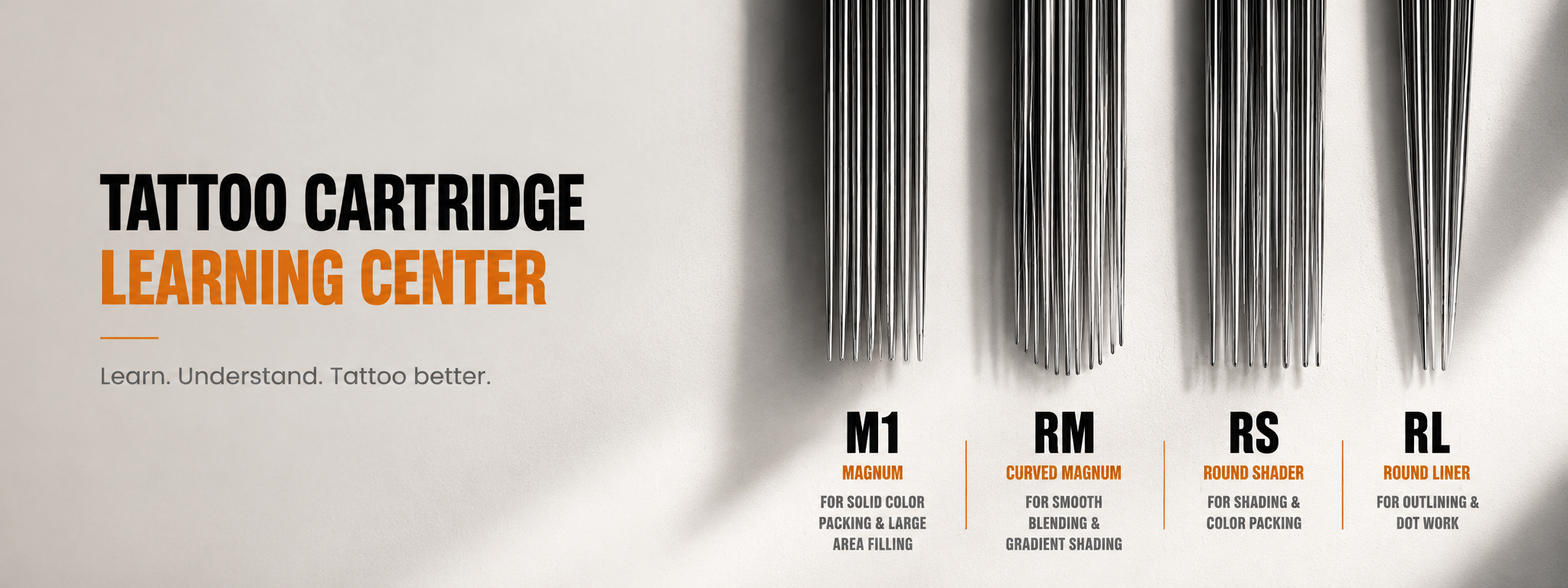
Organise cartridge storage by configuration type and size — round liners together, magnums together, curved magnums together — and within each configuration by size. This makes session preparation faster and reduces the risk of grabbing the wrong configuration in a busy studio.
Label shelves or drawers clearly. In multi-artist studios, consistent organisation means any artist can find supply without disrupting the storage system.
Stock Rotation
New stock goes behind existing stock — always. Check expiry dates when restocking and place newer expiry dates at the back. Any cartridges within 3 months of expiry should be flagged and prioritised for use before newer stock.
Minimum Stock Levels
Establish minimum stock levels per configuration and reorder when you hit the minimum rather than when you run out. Running out of cartridges mid-week is a studio operations failure, not a cartridge problem.
Recommended minimums for a solo artist:
- Primary configuration: 2 boxes minimum at all times
- Secondary configurations: 1 box minimum
For multi-artist studios, scale minimum stock levels by the number of artists using each configuration.
Confirming Sterility Before Use
Before opening any cartridge, confirm that the packaging integrity is intact. A cartridge with compromised packaging should not be used regardless of how it looks.
Visual Checks Before Opening
Seal integrity — the individual blister or pouch seal should be fully intact with no visible breaks, tears, or lifting at the edges. Any visible seal compromise means the cartridge is not sterile and should be discarded.
Packaging condition — the packaging should be clean, dry, and undamaged. Moisture inside the packaging visible as condensation or water marks, chemical staining, or physical deformation of the packaging material all indicate potential sterility compromise.
Expiry date — confirm the expiry date is valid before opening. Don't use expired cartridges.
Indicator marks — some professional cartridge packaging includes sterilization indicator marks that change color or appearance to confirm the EO gas sterilization process was completed correctly. Check these if present.
What Compromised Packaging Looks Like
- Visible tear or hole in the pouch or blister
- Seal that lifts or separates without full resistance when the cartridge is removed
- Moisture or discolouration inside the packaging
- Deformed cartridge body or tip visible through the packaging
- Missing or illegible expiry date
Any of these means discard — do not use.
Disposal After Use
Used cartridges are sharps waste. They must be disposed of in accordance with local sharps disposal regulations — typically in a puncture-resistant sharps container that is then disposed of through an approved medical waste collection service.
Never:
- Place used cartridges in general waste
- Recap used cartridges and return them to storage
- Reuse cartridges between clients or between sessions
- Attempt to sterilize and reuse cartridges — they are single-use by design and cannot be safely re-sterilized
Sharps containers should be clearly labelled, stored in a designated location that clients don't have access to, and disposed of when three-quarters full — never overfilled.
Storage Quick Reference
| Condition | Recommended | Avoid |
|---|---|---|
| Temperature | 15°C–25°C | Above 30°C, below 5°C |
| Humidity | 30%–60% RH | Above 70% RH |
| Light | Ambient indoor | Direct sunlight, UV sources |
| Position | Flat or upright, no pressure | Under heavy items |
| Chemical proximity | Separate storage | Same enclosed space as solvents |
| Stock rotation | FIFO — oldest first | Newest stock in front |
| Pre-use check | Seal, expiry, packaging condition | Use if any compromise visible |
| Post-use disposal | Sharps container | General waste |
Summary
Cartridge storage is professional studio infrastructure — not an afterthought. Optimal conditions are room temperature, moderate humidity, away from direct light, chemical exposure, and physical pressure. Dedicated, organised storage with consistent stock rotation and minimum stock levels prevents supply disruption and maintains cartridge integrity from purchase to use.
Every cartridge should be visually checked for packaging integrity before opening. Any compromise means discard. Used cartridges are sharps waste and must be disposed of correctly — never reused, never returned to storage, never placed in general waste.
Professional cartridge storage is the last line of quality control between the manufacturer's sterility guarantee and your client's skin.
Continue Learning
- How Many Tattoo Cartridges Do You Need Per Session?
- Tattoo Cartridge Compatibility Guide — Which Fits Your Machine?
Recommended for Artists