How to Choose Tattoo Cartridges for Your Machine — Pro Guide
Choosing the right cartridge for your machine is not just about compatibility — it's about matching the cartridge's membrane resistance, needle configuration, and gauge to your machine's drive characteristics, stroke length, and the voltage range you actually work in. A cartridge that performs well on one machine setup can feel completely different on another, and understanding why gives you the ability to make deliberate choices rather than defaulting to whatever the artist next to you is running.
This guide covers how machine characteristics interact with cartridge specs, how to match cartridge to machine systematically, and how to dial in a new cartridge brand on your existing setup.
Why Machine-Cartridge Matching Matters
Every tattoo machine has a characteristic set of operating parameters — stroke length, drive force, voltage range, and speed. Every cartridge has a corresponding set of response characteristics — membrane resistance, needle grouping tension, and ink flow behaviour at different drive conditions.
When machine and cartridge are well-matched, the setup feels natural. The needle return is consistent, ink flow is predictable, and voltage adjustments produce the expected change in output. When they're mismatched, you compensate — adjusting voltage beyond your normal range, changing your technique to work around equipment behaviour, or accepting results that don't match your standard.
Most artists adapt to mismatched setups without identifying the mismatch as the cause. Understanding the machine-cartridge relationship lets you diagnose and fix these problems rather than work around them.
Machine Characteristics That Affect Cartridge Performance
Stroke Length
Stroke length is the distance the needle travels on each downstroke — how far the needle extends and retracts per cycle. It's one of the most significant variables in how a cartridge feels and performs.
Short stroke (1.5mm–2.5mm): Produces a lighter, faster needle action. Less needle throw per stroke means less drive force applied to the cartridge needle bar per cycle. With short stroke machines, membrane resistance becomes more significant — a high-resistance membrane can feel stiff and create a choppy needle return. Lower-resistance or more elastic membranes suit short stroke machines better.
Standard stroke (3.0mm–4.0mm): The range most professional cartridges are calibrated for. Standard stroke produces consistent drive force across the operating voltage range and works well with most professional cartridge membranes.
Long stroke (4.0mm+): More needle throw per cycle. More drive force applied per stroke, more aggressive needle action, deeper potential penetration per pass. Long stroke machines can handle higher-resistance membranes without the stiffness issues that arise on short stroke setups. Needle depth adjustment in the grip becomes more important to prevent over-extension.
Drive Force and Motor Type
The motor type and its drive characteristics affect how much force is applied to the cartridge needle bar per stroke, independent of stroke length.
Brushless DC motors (common in high-end rotary machines) — consistent drive force across the RPM range. The motor maintains torque at low speeds without the fade that some brushed motors exhibit. Cartridge performance at low voltage is more predictable with brushless motors.
Brushed DC motors — drive force can vary more at the extremes of the voltage range. At very low voltages, some brushed motors lose torque consistency, which affects membrane flex regularity. At higher voltages, they perform reliably.
Eccentric/cam drive vs direct drive — eccentric drives convert rotary motor motion to linear needle movement through a cam mechanism. The cam profile affects how smoothly the stroke transitions from downstroke to upstroke. A smooth cam profile produces more consistent membrane flex than an abrupt cam profile.
Voltage Range
The voltage range you work in affects membrane flex frequency and force, which directly impacts ink flow and needle feel.
Low voltage (4V–6V): Slower needle speed, lighter drive force per stroke. Membrane sensitivity matters more at this range — a high-elastic or low-resistance membrane responds more consistently at low voltage than a stiff or high-resistance one. Fine line and realism artists typically work in this range for precision passes.
Standard voltage (6V–9V): The operating range most professional cartridges are calibrated for. Most membrane types perform consistently in this range across standard working conditions.
High voltage (9V–12V+): Faster needle speed, more drive force per stroke. High-resistance membranes that feel stiff at low voltage become more responsive at higher voltage. Heavy color packing and bold linework often happens in this range.
Matching Cartridge to Machine — A Systematic Approach
Step 1: Know Your Machine's Stroke Length
Check your machine's specifications. Stroke length is usually published by the manufacturer. If it's not specified, most professional pen-style machines run 3.0mm–4.0mm standard stroke. Traditional rotary machines vary more widely.
- Short stroke machine → favour lower-resistance, higher-elastic membranes
- Standard stroke machine → most professional cartridges will work
- Long stroke machine → higher-resistance membranes are more manageable; adjust needle depth carefully
Step 2: Identify Your Primary Working Voltage
The voltage range you spend most of your working time in determines which membrane characteristics matter most for your setup.
- Primarily low voltage (fine line, realism) → high-elastic or low-resistance membranes. BigWasp Transparent and Purple lines.
- Standard voltage range → most professional membranes work well. BigWasp Energy line.
- High voltage (bold linework, color packing) → standard to high-resistance membranes. BigWasp Energy Magnum and X lines.
Step 3: Match Configuration to Technique
This is independent of machine characteristics but happens simultaneously with machine matching.
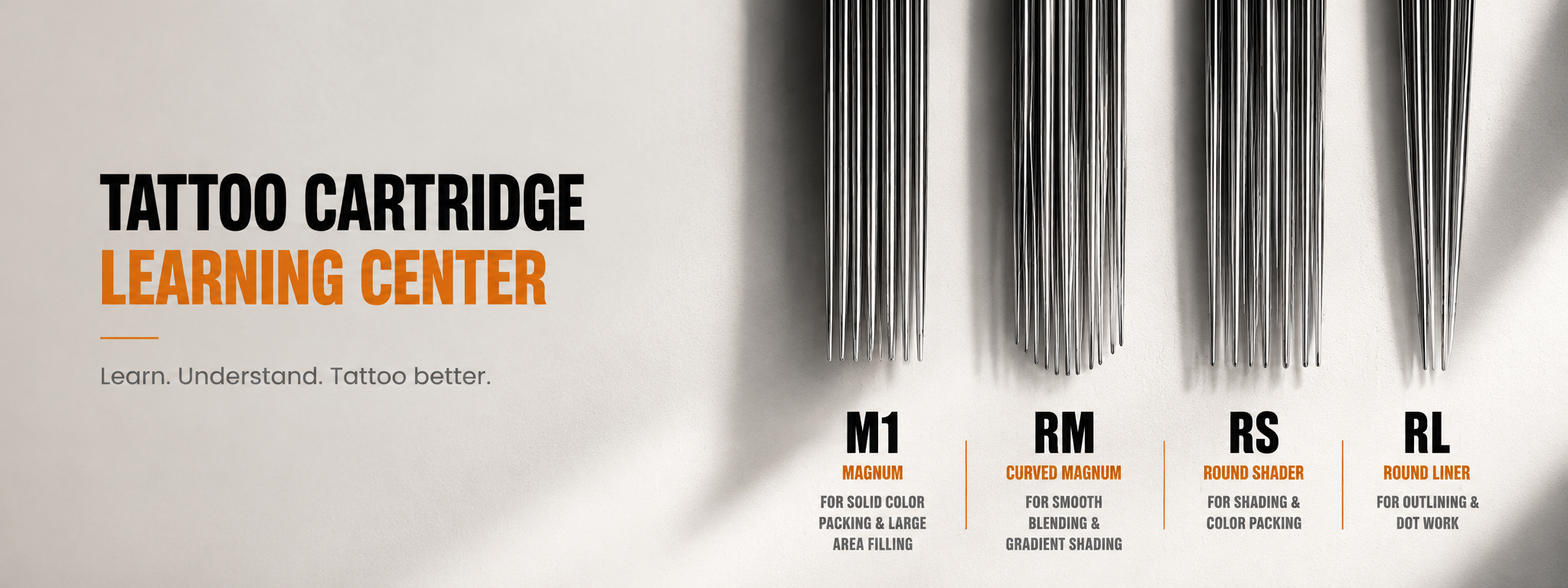
| Technique | Configuration | Gauge | Taper |
|---|---|---|---|
| Fine linework | Round Liner | #10–#12 | Long |
| Bold outlines | Round Liner | #12–#14 | Medium |
| Soft shading | Round Shader | #10–#12 | Medium–Long |
| Color packing | Magnum | #12 | Medium |
| Blending | Curved Magnum | #12 | Medium |
| Realism detail | Round Liner (small) | #08–#10 | Long |
| Dotwork | Round Liner | #10–#12 | Long |
Step 4: Test Before Committing to Volume
When introducing a new cartridge brand or configuration to your machine:
- Order one box of the configuration you'll use most
- Run it at your standard working voltage on a test session
- Assess needle feel, ink flow consistency, and output quality
- Adjust voltage if needed — up if flow is too light, down if too heavy
- If performance is right at adjusted voltage, note the offset from your previous standard
- Order volume once you've confirmed the setup works
Common Machine-Cartridge Mismatches and How to Diagnose Them
Stiff, Choppy Needle Return
Symptoms: The needle feels resistant coming back up on the upstroke. Machine sounds different — more laboured. At low voltage, the needle return is inconsistent.
Likely cause: Membrane resistance is too high for the machine's drive force at the working voltage. Most common on short-stroke machines or at low working voltages.
Solutions:
- Increase voltage slightly to add drive force
- Switch to a lower-resistance or higher-elastic membrane cartridge
- If using a short-stroke machine, choose cartridges specifically suited to lower drive force setups
Heavy, Uncontrolled Flow
Symptoms: Lines are wider than the needle configuration suggests. Shading saturates faster than expected. Color goes in aggressively. Difficult to control tonal build in realism.
Likely cause: Membrane resistance too low for the machine's drive force, or voltage too high for the technique. The membrane is flexing too easily, which allows excessive pressure build and release on each stroke.
Solutions:
- Reduce voltage
- Switch to a higher-resistance membrane cartridge
- For realism and precision work, use a cartridge with a high-elastic membrane that tracks subtle voltage changes more precisely
Light, Inconsistent Flow
Symptoms: Lines are thinner than expected. Shading builds slowly. Color requires excessive passes. Some strokes deposit normally, others are dry.
Likely cause: Membrane resistance too high for the working voltage, needle too dry (insufficient re-dipping), or ink viscosity mismatch.
Solutions:
- Increase voltage
- Re-dip more frequently
- Check ink viscosity — thin slightly if too thick for the capillary system
- Switch to a cartridge with lower membrane resistance if the voltage adjustment required is excessive
Cartridge Feels Different Between Boxes
Symptoms: The first box from a new brand feels right. The second box from the same order feels different — stiffer, or lighter, or with different flow characteristics.
Likely cause: Batch consistency issue. The brand's manufacturing tolerances are wide enough that membrane resistance and needle grouping characteristics vary between production runs.
Solutions:
- Switch to a brand with tighter manufacturing tolerances and better batch consistency
- This is a brand quality signal, not a machine adjustment problem
Setting Up for Multiple Configurations
Professional artists switch between configurations regularly — liner to shader to magnum within the same session. Managing multiple configurations on the same machine setup requires understanding how each configuration's characteristics interact with your machine.
Within the same cartridge brand and line: Configurations from the same product line are engineered with consistent membrane characteristics. Switching from a round liner to a magnum within the BigWasp Energy line, for example, doesn't require significant voltage adjustment — the membrane resistance is consistent across configurations.
Between different cartridge brands or lines: Different brands and lines have different membrane resistance characteristics. Switching between a BigWasp Energy round liner and a BigWasp X magnum may require a small voltage adjustment because the membrane engineering differs between lines. Document your voltage settings per configuration-brand combination and refer to your notes when switching.
Voltage presets: Many modern professional machines allow you to save voltage presets per configuration. Setting up presets for each cartridge-configuration combination you use regularly eliminates mid-session adjustment time and keeps your setup consistent across sessions.
Machine-Specific Considerations
FK Irons
FK Irons rotary machines typically run standard stroke lengths and work well with most professional cartridge formats. Standard and high-quality silicone membranes perform consistently across the FK Irons operating range. At the lower voltage settings some FK Irons users prefer for detail work, high-elastic membranes offer better sensitivity.
Bishop Rotary
Bishop machines, including the Fantom and Needle Pen, run standard to slightly longer stroke configurations. Most professional cartridges are compatible. Bishop's own Da Vinci V2 cartridges are optimised for Bishop machines but standard-format cartridges including BigWasp perform well across the Bishop operating range.
Cheyenne Hawk Thunder and Similar
Standard stroke, standard drive force. Compatible with all standard-format cartridges. Well-suited to the full BigWasp range across Energy, Purple, Transparent, and X lines. The Cheyenne Hawk systems that use standard cartridge grips run BigWasp cartridges without adjustment from standard settings.
Pen-Style Machines (General)
Most professional pen-style machines run in the standard stroke range. The pen form factor doesn't change cartridge performance — compatibility and membrane matching follow the same principles as any other rotary. Confirm stroke length from the manufacturer spec sheet and apply the same matching logic.
Summary
Choosing cartridges for your machine means understanding both sides of the equation — the machine's stroke length, drive force, and working voltage range, and the cartridge's membrane resistance, configuration, and gauge.
Short stroke or low-voltage setups benefit from lower-resistance, higher-elastic membranes. Standard setups work with most professional cartridge membranes. Long stroke or high-voltage setups can handle higher membrane resistance.
Test before committing to volume. Document your settings. When a setup feels wrong, diagnose whether it's machine or cartridge before adjusting technique to compensate. The right machine-cartridge combination makes consistent professional output the default — not something you have to work against your equipment to achieve.
Continue Learning
- Tattoo Cartridge Compatibility Guide — Which Fits Your Machine?
- Cartridge Membrane Guide — Why It Matters for Ink Flow
- Choosing Cartridges by Tattoo Style — The Complete Guide
Recommended for Artists